
Talos Is Designed
For Enterprise Security
Enterprise-grade private model inference with verifiable security controls, flexible isolation tiers, and specialized AI agents orchestrated to defend, monitor, and operate enterprise systems
Built-In Compliance & Auditability
- SOC 2-ready audit trails are created with every agent action
- Code never crosses jurisdictional boundaries to ensure data residency compliance
- Full action logging in autonomous mode — every decision is traceable
- Role-based access controls and approval workflows
One Endpoint Interface
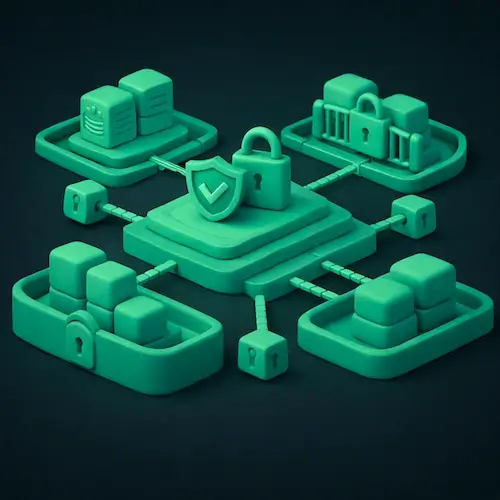
Talos connects to inference you control through a secure endpoint defined by a URL and credentials. Whether reasoning runs on local models on your own hardware or through your own approved cloud, the platform experience and integrations remain unchanged. Daedalus never hosts your inference.
- Point Talos at local models or your own cloud — no code changes
- Switch or migrate endpoints without disrupting active workflows
- Maintain consistent security, auditability, and operational behavior
Verifiable Audit Logging
All model access, execution activity, and administrative actions are recorded in tamper-resistant audit logs designed for enterprise security review. Logs provide visibility into when processing occurred, which identities were involved, and how environments were accessed—without storing sensitive prompt or response content beyond required operational boundaries.
Immutable Logging
System, user, and administrative events
Customer-Scoped Visibility
Aligned to deployment isolation
Exportable Records
Compliance, forensics, and internal review
Every Action Has a Name Behind It
Attribution and governance are not bolted on. They are how Talos starts every session and signs every delivery — the controls SOC 2, SOX, and FedRAMP auditors ask for first.
Identity bound to every action
Every event names the human responsible by corporate email, or the service account by ID. Sessions require an authenticated identity from your IdP — no anonymous activity, no “system” placeholder.
Revocation in minutes, not weeks
When an employee is disabled in your identity provider, they cannot start new sessions and lose in-flight access within five minutes. Termination propagates without waiting on a manual offboarding queue.
Bot identity separate from the developer
Delivery happens through dedicated bot identities, distinct from a developer’s personal credentials. The developer triggers, the bot signs and pushes, the reviewer approves — three identities, three audit entries for clean segregation of duties.
Admin policy as a hard floor
Isolation, network, approval, and audit requirements are set once by your security team and delivered as signed, versioned policy. Developers cannot weaken them from the command line or local config.
Containment You Can Attest To
Talos models runtime safety on two independent axes, and your organization policy — carried in the encrypted license bundle, not set by individual developers — decides which combinations a user is permitted. Every option runs locally on your own machine; there is no third-party cloud sandbox.
Isolated sandbox container
- Only the project workspace is mounted — SSH keys, cloud credentials, and secrets are never visible to the agent.
- Network egress is forced through an allowlisted proxy, or cut off entirely.
- Ending the session discards the container with no remnants — a real kill-switch.
- The blast radius is the container, not the host, which is what makes autonomous mode safe to offer.
Per-command kernel confinement
- For work that runs directly on the host, every shell command is confined at the kernel level.
- Enforced by default on macOS, Linux, and Windows.
- Read-only by default; workspace-write or full access only when policy allows.
- Strictness is set by license policy at the corporate level — never by the developer.
Encrypted End-to-End
Talos encrypts every category of data it handles — at rest on every device that touches it, and in flight across every network hop. There is no “we’ll encrypt that next quarter” surface area.
What “Air-Gapped” Actually Means
The question an auditor really asks isn’t “does any traffic leave?” — it’s “does any traffic leave to a destination outside our authorization boundary?” Air-gap is a spectrum of isolation postures, and your admin policy sets which point applies across your organization.
Air-gapped means no untrusted external connections. And in every isolated posture, the Daedalus Knowledge Base supplies the version-current engineering authority a frozen, training-cutoff model can’t — so isolation is no longer a productivity penalty.
Security Resources & Trust Center
Security Controls
Review the technical, operational, and administrative safeguards that protect code, data, and infrastructure.
View controlsCompliance Documentation
Access policies, attestations, and supporting materials aligned to regulated enterprise requirements.
View ComplianceAudit & Reports
Obtain independent assessments, architecture artifacts, and validation evidence prepared for security review.
View ResourcesSecurity FAQ
Explore common security, isolation, and compliance questions from enterprise teams.
View FAQ